
The Business Leader's Guide to Cybersecurity: Part 2 - Communicating Value and Making Smart Investments
Leader’s guide to cybersecurity
How to Talk About Security and Budget Wisely (Without Being Technical)
Welcome to Part 2
In Part 1 of this series, we covered the fundamentals: reframing security as a business problem, the three questions that really matter, and the 80/20 of cybersecurity controls.
Now it's time to tackle the practical challenges:
How do you talk to clients about security when you're not technical?
What compliance frameworks do you actually need?
How do you budget for security without overspending or underinvesting?
This is where security becomes a competitive advantage instead of a cost center.
Let's dive in.
Part 1: How to Talk to Clients About Security (Without Sounding Like IT)
One of the biggest challenges business leaders face: answering security questions in sales calls when you're not technical.
Here's how to do it with confidence:
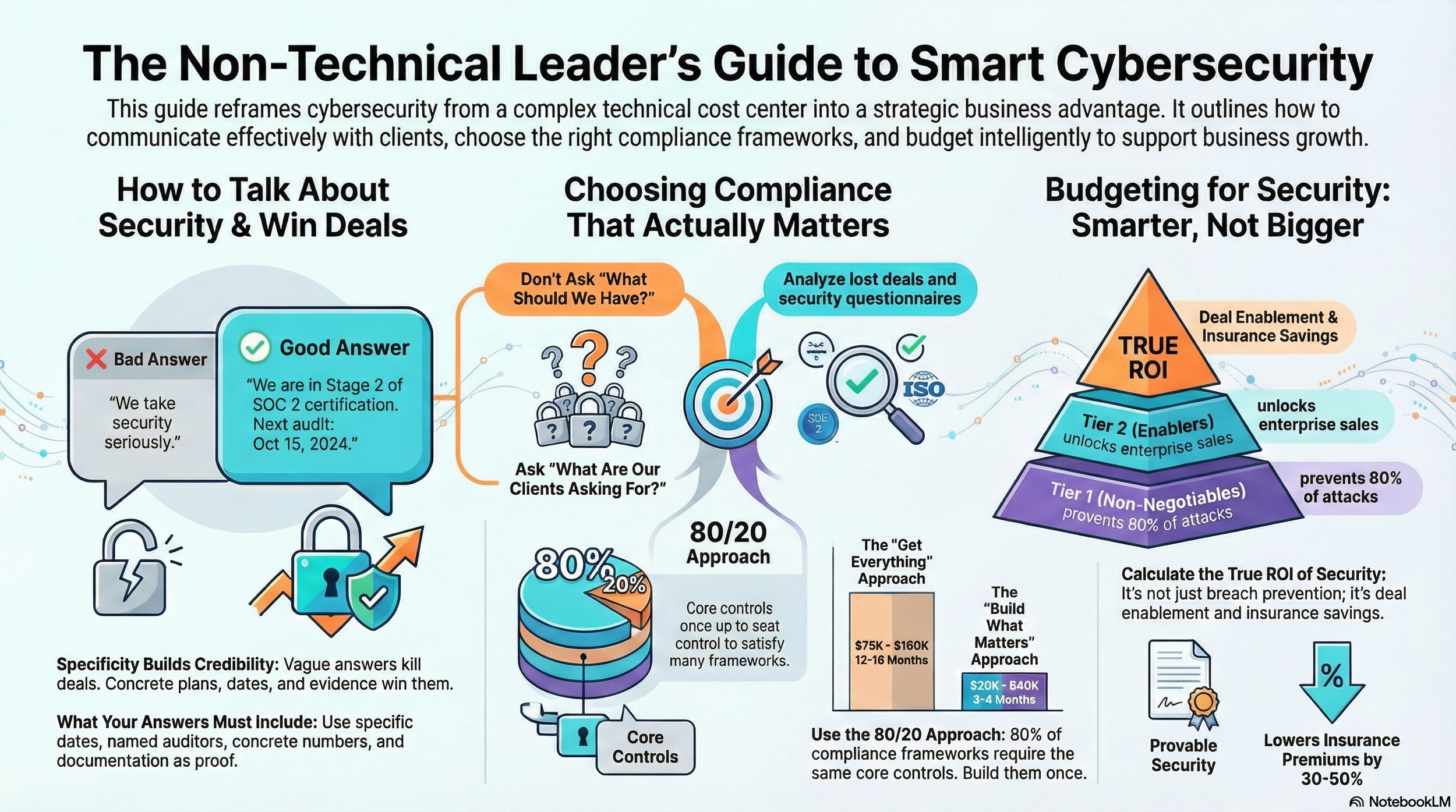
The Framework: Specific Beats Perfect
Clients don't expect perfection. They expect credibility.
❌ Bad Answer: "We take security very seriously. We're working on several initiatives." (Translation: "We don't have a clear answer and hope you stop asking.")
✅ Good Answer: "We're currently in Stage 2 of SOC 2 certification with [Auditor], expected completion in Q2. Here's our scope and current control status." (Translation: "We have a plan, we're executing it, and here's proof.")
Template Responses for Common Questions
Q: "Are you compliant with [Framework]?"
If YES: "Yes, we completed [Framework] certification in [Date]. Here's our certificate and scope documentation."
If IN PROGRESS: "We're currently implementing [Framework] controls, expected completion [Date]. Here's our project timeline and what's already in place."
If NO: "We're not currently certified, but we do implement [Specific Controls] that map to [Framework] requirements. Happy to walk through our security program."
Q: "What happens if you get breached?"
Template Answer: "We have a documented incident response plan that includes:
Detection within [X] hours through 24/7 monitoring
Immediate containment procedures
Clear communication protocol (we'll notify you within [X] hours)
Recovery from tested backups within [X] days
Post-incident review and improvements
We test this plan [frequency] and our last test was [date]."
Q: "How do you protect our data?"
Template Answer: "We protect data through multiple layers:
Access control (only authorized personnel can access specific data)
Encryption (data is encrypted at rest and in transit)
Monitoring (we track access and get alerts for anomalies)
Regular security assessments (last one: [date])
Vendor security reviews (we vet all third parties who touch data)
Happy to walk through any specific aspect in more detail."
The Secret: Specificity = Credibility
Notice what makes these answers work:
Specific dates and timelines
Named vendors/auditors
Concrete numbers (hours, days, frequency)
Evidence of action (test results, certifications, documentation)
You don't need to explain how AES-256 encryption works.
You need to show that you do it, test it, and can prove it.
Part 2: The Compliance Question (What Do You Actually Need?)
Every cybersecurity consultant wants to sell you the full compliance stack:
"You need SOC 2, ISO 27001, NIST CSF, GDPR compliance, HIPAA if you might ever work with healthcare, PCI if you might ever process payments..."
Then they send you a $75K proposal with a 12-month timeline.
Here's the truth: Most of that is overkill.
The Right Question
Don't ask: "What compliance frameworks should we have?"
Ask: "What are our clients actually asking for?"
How to Figure Out What You Need
Step 1: Pull up your last 10 lost deals or stalled opportunities.
Step 2: Look at the security questionnaires and objections.
Step 3: Find the pattern.
Common Patterns:
If your clients are asking:
"Are you SOC 2 compliant?"
"Can you fill out our security questionnaire?"
"What's your data handling process?"
You need: SOC 2 readiness (or full certification if deals are dying without it)
If your clients are asking:
"Are you HIPAA compliant?"
"Can you sign a Business Associate Agreement?"
"How do you handle protected health information?"
You need: HIPAA compliance program
If your clients are asking:
"Do you process credit card data securely?"
"Are you PCI compliant?"
"What's your payment security process?"
You need: PCI DSS compliance
If your clients are European or asking:
"Are you GDPR compliant?"
"Can you sign a Data Processing Agreement?"
"What's your data retention policy?"
You need: GDPR compliance program
The 80/20 Approach
Here's the secret: 80% of what these frameworks require is the same core controls.
Build these once:
Access management
Data encryption
Incident response
Security training
Vendor management
Regular security assessments
Documentation and policies
Then map them to whatever framework your clients care about.
It's not "building SOC 2 from scratch."
It's "documenting what we're already doing in SOC 2 format."
Big difference in cost and timeline.
The Business Case
Scenario 1: The "Get Everything" Approach
Cost: $75K-$150K
Timeline: 12-18 months
Result: Certificates you might not need, documentation nobody reads
Scenario 2: The "Build What Matters" Approach
Cost: $20K-$40K
Timeline: 3-4 months
Result: Can answer client questions, close deals, reduce insurance premiums
Start with Scenario 2. Expand to Scenario 1 when revenue justifies it.
Part 3: Making Smart Security Decisions on a Budget
The biggest myth in cybersecurity: "Good security requires massive budgets."
That's what vendors want you to believe.
Here's the reality: Most security failures come from not doing basic things, not from lacking expensive tools.
Where to Spend First (Budget Priorities)
Tier 1: The Non-Negotiables (Do These First)
Multi-Factor Authentication - Cost: $3-5/user/month
Business-Grade Backups - Cost: $500-2K/month depending on data volume
Basic Security Training - Cost: $20-40/user/year
Antivirus/Endpoint Protection - Cost: $5-10/user/month
Total for 50 employees: ~$1,500-3,000/month
This prevents 80% of common attacks.
Tier 2: The Enablers (Do These When Revenue Justifies It)
Security Operations Monitoring - Cost: $2K-5K/month
Vulnerability Management - Cost: $300-1K/month
Email Security (Advanced) - Cost: $3-7/user/month
Compliance Framework Implementation - Cost: $15K-40K (one-time)
Total addition: ~$3K-7K/month + initial framework investment
This enables enterprise sales and reduces insurance costs.
Tier 3: The Optimizations (Do These When You're Scaling)
Security Information & Event Management (SIEM) - Cost: $5K-15K/month
Penetration Testing - Cost: $15K-35K/year
Full-time or Fractional CISO - Cost: $5K-15K/month (fractional) or $150K-250K/year (full-time)
Advanced Threat Detection - Cost: $5K-15K/month
Total addition: ~$10K-30K/month
This is mature security for companies with serious compliance needs.
The ROI Calculation That Matters
Don't think of security as pure cost.
Think of it as:
Deal enablement: How many $500K+ deals are stuck in "security review"?
Insurance savings: What's your cyber insurance premium? (Can often save 30-50% with good documentation)
Breach prevention: What's your revenue per day? (Average breach costs 21 days of downtime)
Efficiency: How much time do your executives spend in meetings about security issues that could be prevented?
Real Example:
Company revenue: $15M/year Security investment: $50K/year (Tier 1 + partial Tier 2)
Returns in Year 1:
Closed 2 enterprise deals previously stuck: $800K in new revenue
Reduced insurance premium: $11K savings
Avoided ransomware incident (industry average cost): $200K+ saved
Executive time reclaimed: 200+ hours
ROI: 1,522%
How to Know When to Invest More
Simple questions:
Are you losing deals due to security questions? → Invest in compliance documentation
Is your insurance premium increasing? → Invest in provable controls
Is your team overwhelmed with security tasks? → Invest in fractional CISO support
Are you pursuing enterprise clients? → Invest in SOC 2 or relevant certification
Do you handle sensitive data (health, financial, personal)? → Invest in monitoring and incident response
If you answered "no" to all of these, Tier 1 controls are probably sufficient.
If you answered "yes" to 2+, it's time to move to Tier 2.
Part 4: Why Your Insurance Premium Just Doubled (And How to Fix It)
Got a cyber insurance renewal with a 40% increase?
Your broker probably said something like: "Market conditions... increasing claims... industry-wide trend..."
That's half true.
Here's the full story:
Insurance companies don't price on "how secure you are." They price on "how much can we prove you're doing."
Last month, a client came to me with a renewal quote that went from $18K to $29K.
Same business. Same revenue. Same systems.
What changed? The insurance company started asking better questions.
Here's what they actually want to see:
✅ MFA everywhere (not just email, everywhere employees access data) ✅ Documented backup process (not "we back things up," but schedules, retention, and proof of restoration tests) ✅ Security awareness training (with completion tracking and phishing simulations) ✅ Incident response plan (documented, reviewed, and tested annually) ✅ Privileged access management (who has admin rights, how are they monitored)
The kicker?
Most companies are already doing 70% of this. They just can't prove it because it's not documented.
We rebuilt that client's security documentation in 3 weeks.
New quote came back at $19K.
Here's what this actually means for your business:
Every dollar you spend on "provable security" saves you 3-5x in insurance premiums over 3 years.
But here's the part that makes this really worth it:
The same documentation that lowers your insurance premium is the same documentation that closes enterprise deals.
So you're not spending money on insurance compliance.
You're spending money on revenue enablement that happens to also fix your insurance problem.
Your Action Plan: What to Do This Week
Based on where you are, here's what to tackle:
If you're losing deals to security questions:
This Week:
Pull your last 10 security questionnaires
Identify the top 10 questions you struggled to answer
Assess: Do you not do these things, or can you just not prove it?
This Month:
Document what you're already doing
Build a security questionnaire response library
Identify which compliance framework your prospects care about most
Create a plan to get there (with timeline and budget)
This Quarter:
Start SOC 2 readiness process (or relevant framework)
Engage fractional CISO who can join sales calls
Train sales team on how to position your security program
Track deal velocity before and after improvements
If your insurance premium is increasing:
This Week:
Request the detailed questionnaire from your insurance broker
Identify what documentation they're asking for
Assess what you're doing vs. what you can prove
This Month:
Document your backup processes (with test results)
Prove MFA implementation across systems
Document security training program
Create or update incident response plan
This Quarter:
Get quotes from 3 different cyber insurance providers
Use documented controls to negotiate better rates
Implement any gaps that are driving premiums up
What's Next
In Part 3 of this series, we'll cover:
How to work with security professionals without getting snowed
Questions to ask when evaluating vendors
Building a security program that scales with your business
Comprehensive action plans for different growth stages
Need Help Now?
Want to assess where you are? Book a free 30-minute assessment call.
We'll review:
Where you are vs. where you need to be
What's blocking deals or increasing costs
Clear next steps with timeline and budget
How fractional CISO support could help
No sales pitch. No 50-page proposal. Just clear guidance.
[Book Your Free Assessment → https://calendar.app.google/83MPdGMv8e4wk6SU9]
About MP Cybersecurity Services
We provide fractional CISO services for growing businesses that need strategic security leadership without the $200K+ salary of a full-time hire.
Our clients get:
Strategic security guidance tailored to their business
Someone who can answer enterprise security questions
Compliance framework implementation (SOC 2, ISO 27001, HIPAA, etc.)
Documentation that enables deals and reduces insurance costs
Incident response support when you need it
Think of us as your security leadership team, available when you need us, at a fraction of the cost of full-time hires.
Connect with us: Email: [mp@mpcybersecurity.co.uk] Website: [mpcybersecurity.co.uk]