
Hey,
Last week was about passing Security+. This week is the question underneath every study plan: are you studying what you actually need? It takes one honest hour to find out.
🔥 THIS WEEK’S INSIGHT: You Can’t See Your Own Gaps
Here’s a pattern I see all the time. Someone studies for months. They know networking well, they love Wireshark, they can talk about firewalls for an hour. Then they open a real job ad, and half of it describes things they’ve never touched.
It isn’t a lack of effort. It’s that we study what feels comfortable. We return to the topics we enjoy and already understand, because they feel like progress. The gaps stay out of sight until an interview, or a job spec, exposes them.
You can’t fix that by thinking harder. You fix it by letting the job market tell you.
The 10-job-spec test
Pick one target role. Not three. “SOC analyst” or “GRC analyst”, not “something in cyber.”
Pull 10 real postings for that role, at junior or entry level, in the place you want to work.
Copy out the requirements. Focus on the tasks (the verbs), not just the tools. “Triage alerts,” “maintain a risk register,” “write incident reports.”
Tally what repeats. Count how many of the 10 postings mention each requirement. The ones that appear in six or more are the real baseline. The ones that appear once or twice are noise.
Score yourself, honestly. For each repeating requirement, mark one of these:
Strong: I’ve done it, and I could show you proof.
Some: I understand it, but I haven’t done it yet.
None: I haven’t touched it.
“Strong” has one rule: if you couldn’t show me a project, a write-up or a lab, it isn’t Strong. That’s a harder standard than most people use, and it’s the one a hiring manager uses.
An example, made up to show the method (not real data):
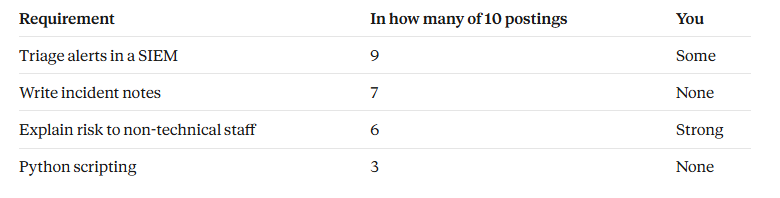
In this example, the top gap is incident notes. It appears often, and the score is None. Python appears less often, so it can wait, even if it’s more fun.
A rule of thumb I use: if you can honestly show about 60% of what keeps repeating, apply, and show your closest evidence for each gap. You don’t need to tick every box. You need to know exactly where your boxes are.
Closing a gap costs nothing. Using the example table:
Triage alerts in a SIEM: build a free lab (Wazuh or Security Onion) and triage the sample alerts. My SOC home lab guide walks you through it: [LINK].
Write incident notes: take a free public incident challenge (CyberDefenders or Blue Team Labs Online), write it up as if for a manager, and put it on GitHub.
Python scripting: write one small script that pulls failed logins out of a log file.
One gap, one small project, one piece of proof.
📰 ONE THING TO KNOW THIS WEEK
SANS and GIAC’s 2026 workforce research asked organisations whether their bigger problem was not enough people or not the right skills. 60% said skills gaps. 40% said staffing shortages. Read the report.
When an employer says “skills gap,” they mean specific skills, not a general lack of enthusiasm. Candidates who can say exactly what they can do, with proof, are easier to say yes to. That’s what the test above gives you.
🛠️ FREE TOOL OF THE WEEK: The Skills Gap Tool
Choose your target role, and it shows where you stand against what employers ask for, so you can stop guessing what to study next.
Free, with no signup to see your results
A fast starting point before you do the full 10-spec test
Best used alongside the test, because real postings in your own area are the final check
Use it first for a quick read. Then do the test and compare.
💡 CAREER ADVICE FROM THE HIRING TABLE
When I read a CV, I’m not scanning for everything. I’m looking for the three or four things the job really needs.
If you’ve closed the top gaps with proof, I can see that in thirty seconds. If you’ve collected ten extras but missed the core, I can see that too.
Two practical points:
Close the gaps in order of how often they appear, not how interesting they are. The top gap on your list is the next thing to study.
“Some” is an acceptable answer. In an interview, “I haven’t used that yet, here’s what I’ve done that’s closest, and here’s how I’d learn it” is a strong answer. It’s honest, and it shows how you think. Claiming “Strong” for something you can’t show is what costs you.
One gap becomes one small project. That’s how a gap becomes proof.
🎯 YOUR ONE ACTION THIS WEEK
Run the 10-job-spec test.
Pull 10 junior postings for one target role.
Tally the five requirements that repeat the most.
Score yourself on each: Strong, Some or None.
Pick the top gap, and decide on one small project that would turn it into proof.
Then write the score down. It’s the most useful page in your whole study plan.
All you need is a job board, a spreadsheet and an hour.
🧰 FREE TOOLS, IF YOU HAVEN’T TRIED THEM YET
🧭 Not sure which path? path.mpcybersecurity.co.uk matches your background and working style to one path.
📊 Not sure what to study next? skills.mpcybersecurity.co.uk shows what’s missing for your target role.
🧠 Preparing for Security+? practice.mpcybersecurity.co.uk gives you an explanation on every answer.
📄 Ready to apply, but hearing nothing? cv.mpcybersecurity.co.uk shows what the software sees first.
All free. No signup required to see your results.
🔜 IF YOU’D LIKE SOMEONE TO CHECK YOUR SCORE
Everything in this issue is free, and you can do all of it on your own. Plenty of people do. If you’d rather have someone check whether your “Strong” would hold up in front of a hiring manager, that’s what the CTRL+ALT+DEFEND Community on Skool is for.
Six-week study plans for SOC, GRC, IAM, Cloud and Pentest, built around the gaps that keep showing up, at 3-4 hours a week.
A real work ticket every week, with a model answer, so you can turn a gap into proof you can show.
A scenario question every day, and a live Q&A with me every Wednesday at 8pm GMT.
CV and portfolio reviews from someone who hires for these roles.
No guarantees, and I can’t promise you a job. It’s $39 a month, and you can cancel any time.
👉 Join here: https://www.skool.com/mpcyber/about
Hit reply and tell me the top gap on your list. I read every one, and it helps me decide what to cover next.
See you next week.
Marius Poskus Global VP of Cybersecurity / CISO CTRL+ALT+DEFEND
→ Skool Community: https://www.skool.com/mpcyber/about
→ Find Your Path: path.mpcybersecurity.co.uk
→ Skills Gap: skills.mpcybersecurity.co.uk
→ Security+ Practice: practice.mpcybersecurity.co.uk
→ CV Checker: cv.mpcybersecurity.co.uk
→ YouTube: youtube.com/@mpcybersecurity