
Issue #7 — AI Security: The Skill Gap Nobody's Filling
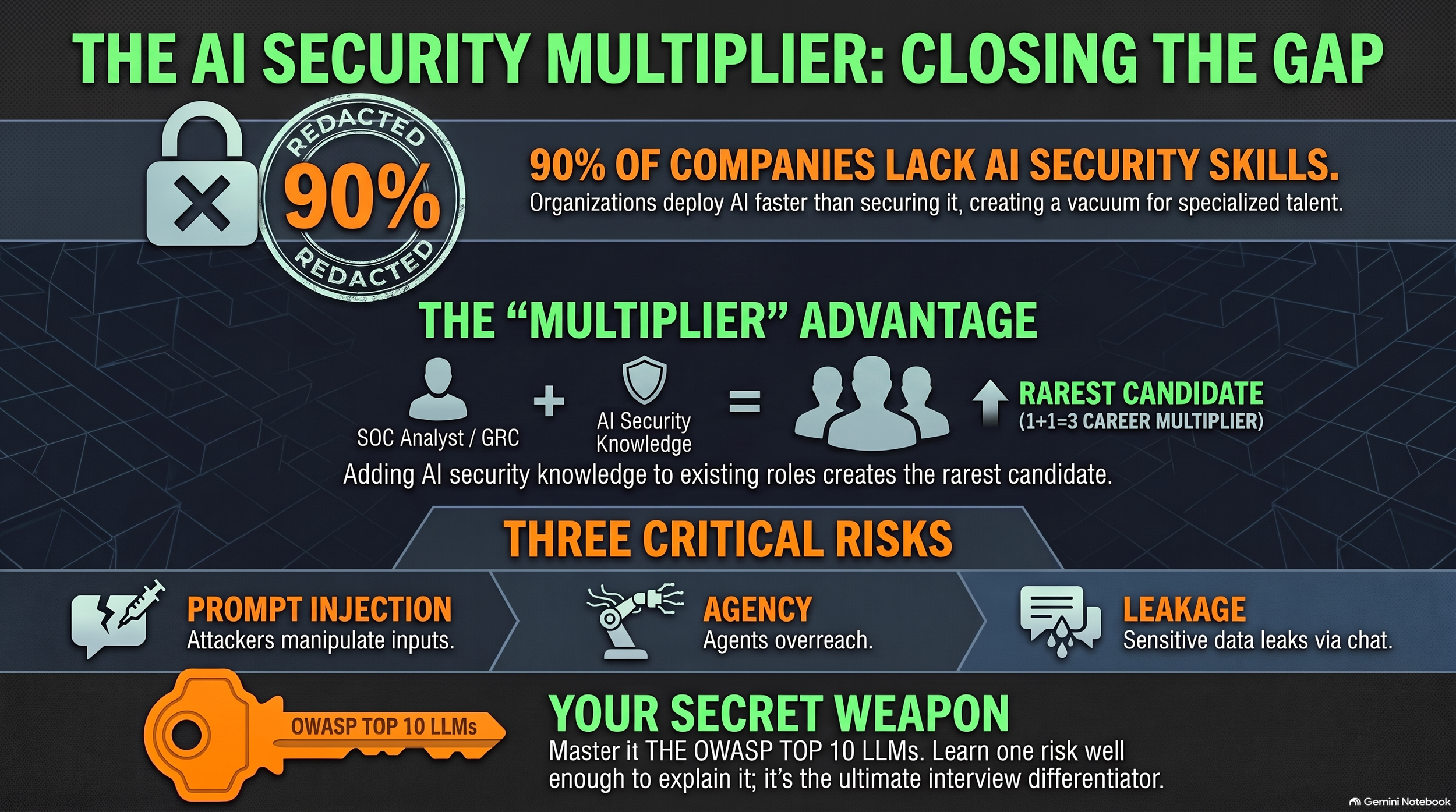
🔥 THIS WEEK'S INSIGHT: The Gap Nobody's Filling Yet
Ninety percent of organisations report skills shortages specifically in AI security. Not general cybersecurity. AI security specifically, the discipline of securing the AI tools, models, and agents that companies are deploying faster than anyone can properly assess the risk.
Here's why this matters for you regardless of which path you're on. AI security isn't a standalone entry-level career yet, in most companies there isn't a dedicated "AI Security Analyst" job posting waiting for you. What it is right now is a multiplier skill. SOC analyst plus AI security. Cloud security engineer plus AI security. GRC analyst plus AI security. Whichever path you're already building toward, layering this knowledge on top makes you one of the rarest candidates in the room, because almost nobody at entry level has bothered yet.
The three things actually worth learning this week:
Prompt injection. The single most common attack against AI systems. An attacker manipulates an AI's input to make it ignore its instructions, leak data it shouldn't, or take actions it wasn't supposed to take. If you can explain this clearly in an interview, you're already ahead of most candidates.
Excessive agency. As companies deploy AI agents that can take real actions, book things, send emails, query databases, the security risk isn't just what the AI says, it's what it's allowed to DO. Understanding this distinction is exactly the kind of thinking companies are desperately short on right now.
Data leakage through AI tools. Employees pasting sensitive company data into AI chat tools is already a real, ongoing incident category. Understanding the governance side of this, acceptable use policies, data classification, tool approval processes, is a GRC-flavoured AI security skill that barely anyone is developing yet.
📰 ONE THING HAPPENING IN CYBERSECURITY THIS WEEK
Every board meeting in 2026 now includes some version of the same question: "What are we doing about AI security?" It's not a technical question, it's a governance one. Boards want to know what AI tools are in use, who approved them, what data they can access, and whether the company is compliant with emerging AI regulation.
This is quietly becoming one of the fastest-growing responsibilities for security leaders, and it's creating demand for people who understand AI risk at every level, not just the technical implementation.
🛠️ FREE TOOL OF THE WEEK: The OWASP Top 10 for LLMs
What it is: A free, structured framework listing the ten most critical security risks specific to large language models, prompt injection, insecure output handling, training data poisoning, and more.
Why it matters: This is the single most efficient use of a weekend if you want a genuine head start. It's free, it's authoritative, and almost nobody in an entry-level interview can speak to it confidently yet.
Where to get it: Search "OWASP Top 10 for LLM Applications." Read it once for familiarity, then pick ONE risk and go deep enough to explain it with a concrete example.
Portfolio move: Pick one risk from the list, prompt injection is the most accessible starting point, and write a short explainer document for your GitHub: what it is, a real-world example, and what mitigations exist. This alone puts you ahead of most applicants at any level.
💡 CAREER ADVICE FROM THE HIRING TABLE
Here's the honest version of how to use this. Don't try to become an "AI security specialist" as your primary identity if you're still early in your career, there isn't yet a well-defined entry-level role built around it. Instead, treat it as a single, sharp talking point you can drop into any interview: "I've been studying the OWASP Top 10 for LLMs because I think AI security governance is where this industry is heading, and I wanted to be ahead of it."
That one sentence, backed by genuine understanding of even one risk, signals forward-thinking in a way that almost no other entry-level candidate will match this year.
🎯 YOUR ONE ACTION THIS WEEK
Pick one AI security risk from the OWASP Top 10 list, prompt injection is the easiest entry point, and spend thirty minutes understanding it well enough to explain it to a non-technical friend. That's the whole task. Not the entire framework. Just one risk, understood properly.
🔜 WANT TO GO DEEPER WITH DIRECT GUIDANCE?
AI security is moving fast enough that a single newsletter issue can only point you in the right direction, it can't keep you current as the landscape shifts month to month, and it can't tell you exactly how to position this specific skill for the specific role you're targeting.
That's exactly what happens inside the CTRL+ALT+DEFEND Community. Weekly live Q&A where I cover exactly this kind of emerging topic in more depth, direct to your questions. Study groups organised by career path, so you can see how AI security layers onto whichever specialisation you're building. And every digital product I've built, included at no extra cost.
I'll say the same thing I always say: I'm not promising this guarantees you a job. What I can promise is direct, ongoing access to someone who's tracking exactly where this industry is heading, not just where it's been.
Join here: https://www.skool.com/cybersecurity-careers-guide-1773/about
If you spend thirty minutes on prompt injection this week, you'll walk into your next interview with an answer almost nobody else in the room has. Forward this issue to someone who's been asking what to study next.
See you next week.
Marius Poskus Global VP of Cybersecurity / CISO CTRL+ALT+DEFEND
→ YouTube: youtube.com/@mpcybersecurity
→ Skool Community: https://www.skool.com/cybersecurity-careers-guide-1773/about
→ LinkedIn: linkedin.com/in/marius-poskus
→ Website: mpcybersecurity.co.uk
→ TikTok: @mariusposkus0